Research
Areas of expertise
- Turbomachinery
- High-fidelity simulations (DNS/LES)
- Data-driven closure modeling (GEP)
- Aeroacoustics
- Non-ideal gas simulations
- Roughness effects on heat transfer/flow
Research projects
Simulation projects
Near-exascale simulations of in-service high-pressure turbine vanes
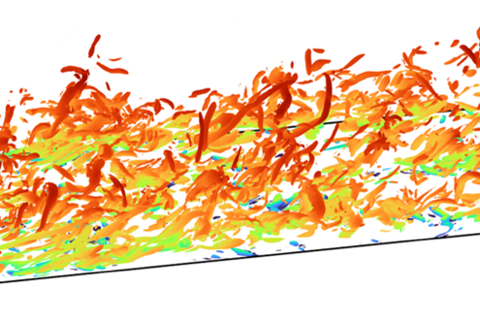
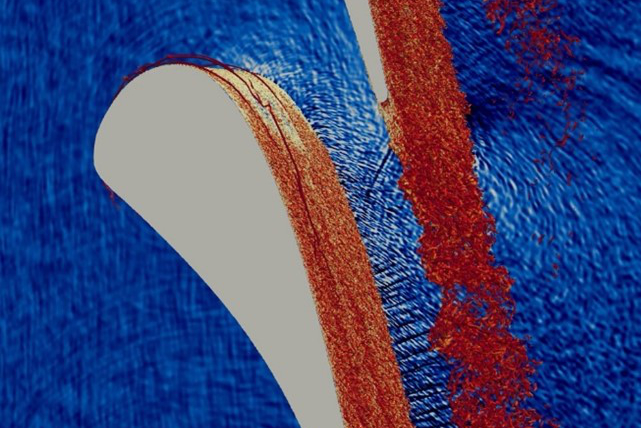
This research uses leadership class computing facilities to advance the understanding of high-pressure turbine aero-thermal performance. The current work focuses on quantifying the effect of surface roughness on film-cooling effectiveness. The overall objective of my research is to translate fundamental scholarship into meaningful outcomes for our industry sponsor, GE Aerospace.
Modelling projects
Toward more general and interpretable physical modelling through machine learning methods
This research focuses on exploring machine learning to generate general and interpretable physical models with low computational costs. With the growth of data from high-performance simulations and experiments, emerging algorithms offer opportunities to uncover physical patterns in flow phenomena, facilitating more efficient methods beneficial to industry.
Advancing Hydrogen Safety via Simulations and Modelling
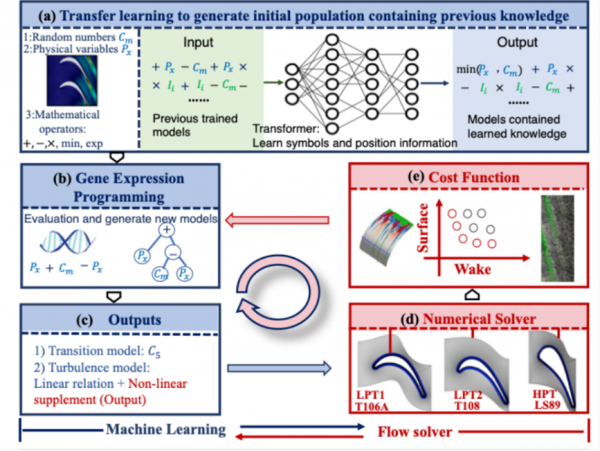
This research focuses on advancing hydrogen safety by leveraging high-fidelity simulations and lower-order modelling of unintended hydrogen leakage scenarios to accurately predict ignition risks. The aim is to address key safety challenges in hydrogen storage and transportation for its commercialization as a next-generation fuel.
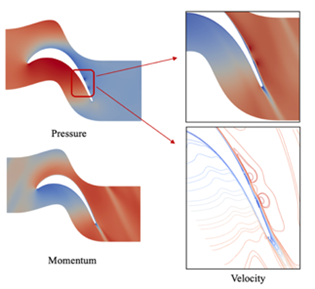
Development of roughness-induced transition models for turbine blades using Machine Learning methods
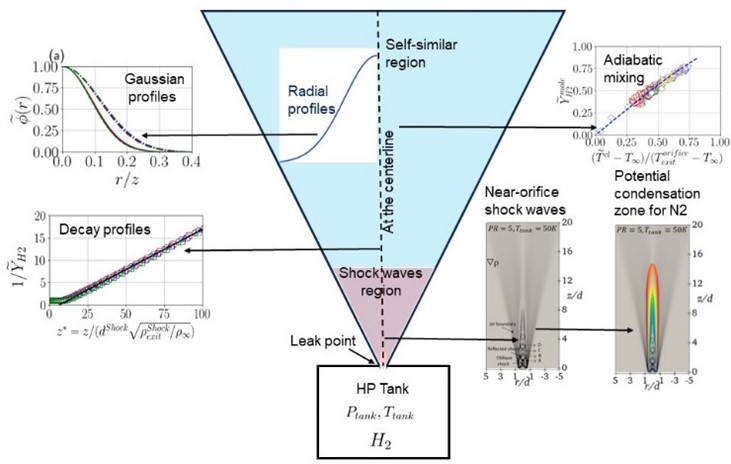
This research extends the Computational Fluid Dynamics-Driven turbulence model training framework to account for surface roughness effects for both separation-induced and bypass transition. The aim is to develop models that accurately predict flow transition over roughened surfaces and thus improve our understanding of the role of roughness in gas turbine performance and longevity.
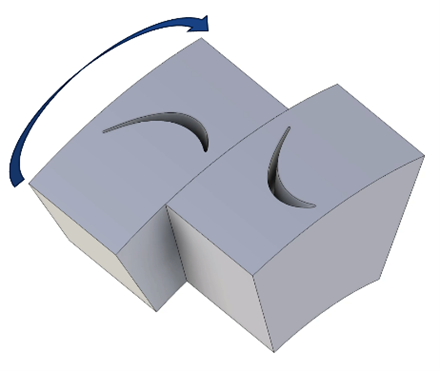
Time-inclined method: toward flexibility in turbomachinery computational fluid dynamics
This project extends the in-house solver HiPSTAR to tackle annulus sector configurations, and therefore numerically predict turbomachinery phenomena related to a varying stator-rotor pitch. This effort enhances our Computational Fluid Dynamics capabilities, toward the ultimate goal of supporting advancements in propulsion and power generation systems.
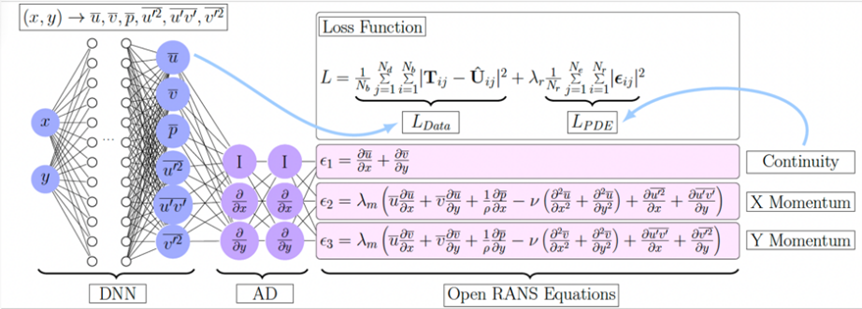
Data-driven wall models for Large Eddy Simulation using symbolic regression
The presence of solid walls can make Large Eddy Simulation computationally expensive. Wall models decrease the grid requirements and therefore cost, however existing models often yield inaccurate results for cases featuring phenomena like separation, strong pressure gradients or transition. This research investigates a new Machine Learning methodology based on symbolic regression to improve wall models.

High-fidelity simulation of Low Pressure Turbines
Understanding the fundamental physical mechanisms occurring inside aircraft engines is vital to increase their efficiency and thus reduce environmental impact. This research focuses on running large-scale simulations of different engine components utilising Australia's supercomputing capability, enabling a close look at the flow physics inside such gas turbines, thus guiding the design of next-generation aircraft engines.

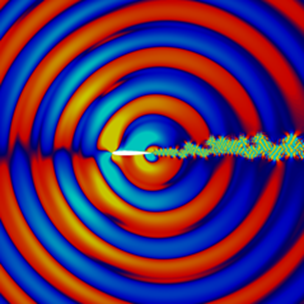
Development of a data-driven, physics-based noise prediction methodology
Noise cannot be accepted anymore as an undesirable by-product in engineering, however a predictive gap is present between academic high-fidelity noise simulations and current industrial low-cost hybrid models. This research uses high-fidelity simulation data of noise-generating geometries to improve low-cost design tools by using resolvent analysis and machine learning.
Effects of surface roughness and riblets on Low Pressure Turbine blades
Sumit Shankar Sarvankar
This research utilises high-fidelity simulations to study flow behaviour over a Low Pressure Turbine blade. The unsteady rotor-stator interaction within the Low Pressure Turbine stage is investigated, as well as the effectiveness of flow control techniques, such as roughness elements or riblets, to mitigate flow separation and enhance aerodynamic performance.

Contemporary data-driven methodologies of data-assimilation and turbulence model correction
This research uses physics-informed machine learning to improve turbulence modelling for industrial applications, with a focus in developing algorithms constrained to the known physics of wall-bounded turbulence. This work aims to improve advanced Reynolds-stress turbulence models, specifically for serpentine ducts, focusing on pressure-strain correlations of the near-wall region.
Multiscale Bird Wing Modelling
Anthony Soler
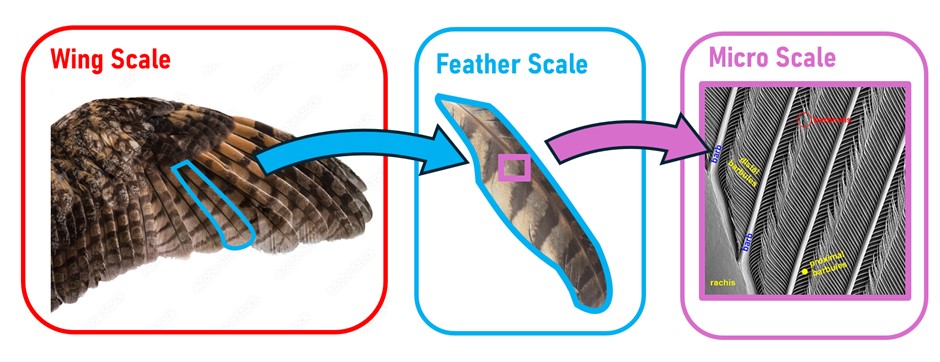
This research examines bird flight by investigating the relationship between feather porosity and wing aerodynamics across a range of scales. While previous studies have explored various aspects of bird flight, little is known about how microscale feather characteristics impact macroscale wing performance.
The study will employ a multiscale approach to analyse the fundamental fluid dynamics at three length scales: the entire wing, individual feathers, and the microscopic surface structure. By examining these interconnected scales, this research aims to develop a more comprehensive understanding of how feather properties influence aerodynamics and wing performance.
It is hoped this multiscale approach will provide a comprehensive view of bird flight mechanics, potentially offering new insights into the intricate physics that enable birds to soar through the air with such remarkable efficiency and agility.
Modeling of compressible flows with resolvent analysis
Yitong Fan
The method of resolvent analysis is developed to accurately model turbulent flows for the design and optimisation of high-speed vehicles. Using a linear resolvent operator, this research permits predictions of turbulent statistics and coherent structures within compressible turbulent boundary layers, without having to solve for the full flow field via high-fidelity numerical methods.